
Birds in This Story
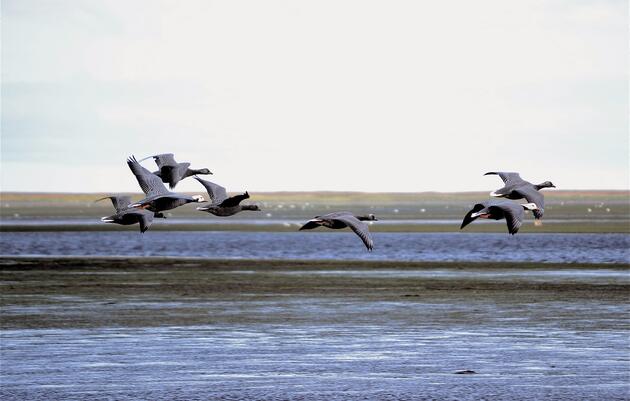
Emperor Goose
Latin: Anser canagicus

Brant
Latin: Branta bernicla

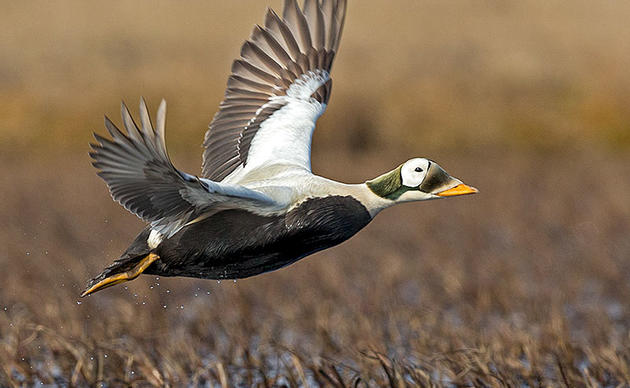
Steller's Eider
Latin: Polysticta stelleri

At the remote meeting point of the Alaska Peninsula and the Aleutian Islands, a proposed 19-mile road through Izembek National Wildlife Refuge threatens one of the most ecologically significant wetlands on the planet. Let’s explore why Izembek’s global importance for wildlife, subsistence, and conservation makes it an unsuitable place for road construction due to the serious impacts it would pose.
Critical Habitat for Wildlife
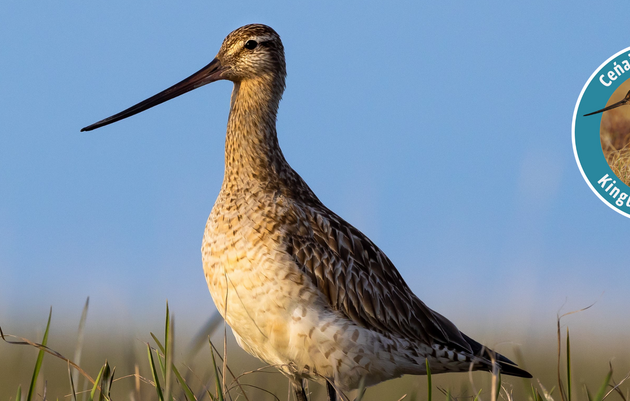
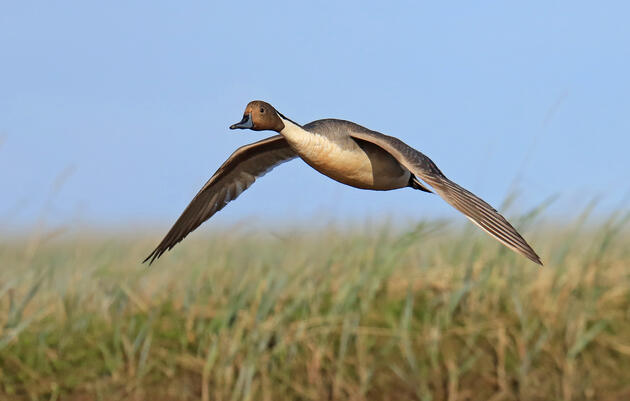
The Izembek National Wildlife Refuge supports exceptionally diverse and abundant wildlife. Izembek’s lagoons house the world’s largest eelgrass beds, and this foundational ecosystem is a key habitat for migratory birds throughout the Pacific Flyway and beyond. Izembek supports hundreds of thousands of aquatic birds, including nearly the entire population of Pacific Black Brant, Emperor Goose, and 70% of the threatened Steller’s Eider. The narrow isthmus between Izembek and Kinzarof lagoons is a critical movement corridor for birds, caribou, brown bear, wolf, and other wildlife, as well as the most important nesting habitat for aquatic birds in the Refuge.
Recognition of Izembek’s ecological importance spans across time, including designation as a National Wildlife Range (1960), State Game Refuge (1972), National Wildlife Refuge and Wilderness Area (1980), internationally important wetland under the Ramsar Convention (1986), critical habitat for Steller’s Eider under the Endangered Species Act (2001), Important Bird Area of global significance (2017), and sea duck key habitat site (2022).
"Izembek"—a short documentary film by Cornell Lab of Ornithology.
An Unsuitable Place for Any Road
Since the 1980s, justifications for a road have included commercial fishing operations and improvements to emergency medical transportation, among other reasons. However, a large body of technical information and numerous policy decisions have highlighted that the proposed road would cause irreparable impact to Izembek’s ecosystem and wildlife. Less impactful and viable alternatives to a road have been identified. In 1998, $37.5 million of federal funding was granted for improvements in local transportation and medical care. Corrected for inflation, this amount currently represents $74 million. In 2023, an additional $43.3 million was granted to improve local infrastructure for maritime transportation.
The road would bisect lengthwise the Refuge’s narrow isthmus and disrupt wildlife movements and water flow in these wetlands. Gravel mining for road construction and maintenance would further degrade high-quality habitats. Construction and vehicle traffic would likely lead to contaminated runoff, dust, and noise. Of special concern, the road would likely facilitate unauthorized use of all-terrain vehicles into the Refuge’s designated Wilderness and increase habitat degradation, disturbance, and hunting pressure in remote areas. The impacts would extend well beyond the road corridor, carried by air, water, and unauthorized use of all-terrain vehicles.
The expense of this proposed road is staggering. Recent estimates indicate that the road would cost $127 million to build and $975,000 per year to maintain. There are no private investors with local interests that could contribute to these costs. Beyond local interests, the proposed road would not have broader benefits to the region, state, or nation. Meanwhile, many of the nearly 300 remote communities in Alaska currently face acute needs for basic infrastructure such as housing and affordable, clean energy.

Impacts at the Continental Scale
The degradation and loss of Izembek’s biological resources would lead to far-reaching socio-economic impacts to communities across Alaska and beyond. Izembek-dependent Brant, Cackling Geese, and other migratory waterfowl are important food and cultural resources for subsistence communities across Alaska. Seventy-seven federally recognized tribes across Alaska have formally opposed the proposed road. Izembek-dependent migratory waterfowl are also traditionally hunted across their non-breeding grounds in the Lower 48 and are highly appreciated for their ecological and aesthetic values.
Building a road through this conservation system unit would create a concerning precedent that would erode long-standing protections to subsistence livelihoods in Alaska and other protected lands in Alaska and elsewhere in the United States. In fact, the proposed road conflicts with (or is inconsistent with) numerous laws and established processes for public decision making, including the National Wildlife Refuge System Administration Act as amended by the National Wildlife Refuge System Improvement Act, Wilderness Act, National Environmental Policy Act, Alaska National Interest Lands Conservation Act (ANILCA Titles XI and VIII), Endangered Species Act, and Administrative Procedure Act.

Voice Your Perspectives
The U. S. Army Corps of Engineers is currently accepting public comments on a permit application for the construction of the proposed road. Please consider adding your voice. Numerous public comments would help to highlight the extraordinary ecological value of Izembek wetlands and the irreparable impacts from the proposed road, as well as a widespread opposition to the road.
How to act:
- Here is a sample of a comment letter that you may download and edit as you’d like.
- Here is where you may view the road permit application.
- Submit your comment via email to regpagemaster@usace.army.mil and John.C.Sargent@usace.army.mil with something in the subject line referencing “POA-2010-00286 Cold Bay.”
- Send your comments by January 12, 2026.
Thank you for your continued support.