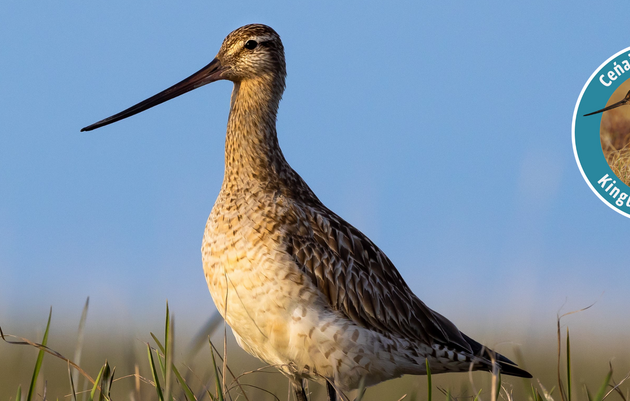

Birds in This Story
Wilson's Snipe
Latin: Gallinago delicata

Bar-tailed Godwit
Latin: Limosa lapponica

There is a bird behind glass in Paris. But this isn’t a zoo, it’s the musée du quai Branly–Jacques Chirac. On display is a mask of a shorebird in mid-motion—its long bill half opened, wings and legs flared, a human-like face emerging from its back. Carved in western Alaska between 1905 and 1916, the sugg’erpak (pronunciation: sooggh’-errh-buck) mask is a survivor of Yup’ik ceremonial art. But today, it offers more than a walking-shoe-stopping item at the musée du quai Branly–Jacques Chirac. There’s a story here.
Shorebirds, while deeply embedded in Yup’ik seasonal life, are rarely depicted in cultural objects. Yet here is a dance mask shaped to unambiguously represent a long-billed shorebird—perhaps a Bar-tailed Godwit or a Wilson’s Snipe, but a species cannot confidently be ascertained—created during a period of upheaval for both Yup’ik people and birds.
Ornithologist Dr. Liliana Naves, Audubon Alaska’s Director of Conservation, encountered the mask while researching Indigenous shorebird harvest and ecological knowledge. Its existence surprised her, even writing about the first time she saw it—digitally, anyway.
“I froze in place as a long-billed shorebird, carved from wood, pixelated into place on my computer screen, revealing on its back a smiling yua spirit face,” she writes.
This encounter eventually led to the paper “A Yup'ik dance mask from the early-1900s connects Indigenous tradition and shorebird conservation” and a journey that connects the Yukon–Kuskokwim Delta to diverse flyways, Indigenous knowledge to Western science, and a century-old carving to today’s urgent conservation challenges. There are also 20th-century eccentric art collectors, a feather identification lab, and a globe-trotting Yup’ik tribal council president who also advocates for migratory birds in another hemisphere.
A Mask From a Time of Disruption
The sugg’erpak mask was carved during a transformative—and traumatic—period for Yup’ik peoples. The early 1900s brought devastating epidemics, suppression of Indigenous spirituality and language, and sweeping socio-economic change. At the same time, bird and shorebird populations were collapsing in the United States due to commercial harvest (often for fashion) and habitat loss. The creation of a shorebird mask during this era could have acted as a connection between these two shifts.
“[Art] documents everything. It's like a textbook,” says Estelle Thomson, the President and Grants & Tribal Development Officer for the Native Village of Paimiut Traditional Council—the Tribal government of the Paimiut People of western Alaska. “It documents everything from the belief systems to scientific and traditional knowledge. It documents culture, documents virtuality, documents all sorts of stuff.”
Thomson’s background is in traditional medicine, cultural education, and Tribal governance. Still, she also sits on the board of the Alaska Wildlife Alliance (among many other boards) and is internationally known as a migratory bird advocate. For example, she also advocates for migratory birds and building Indigenous-led partnerships for nature stewardship in New Zealand.
The sugg’erpak mask‘s design reflects careful attention to bird anatomy, while its yua human-like face (its person) shows the spirit of the mask itself or of its subject. In fact, Thomson refers to birds as migratory kin. “Because they are our relatives,” she says. “In many of our cultures, they are teachers, ancestors …. A lot of our cultures believe that birds are messengers between us and the other world, like the spiritual world, and so there is a strong significance for all of us with birds.”
Into the first decades of the 1900s, Yup'ik people held a cycle of communal ceremonies or festivals during winter, which included sharing food, exchanging gifts, honoring the deceased, thanking and honoring harvested animals, and requesting abundance. That way of requesting or praying for abundance is known as agayuyaraq, and those ceremonies were held in late winter to elicit abundant harvests in the upcoming year. Agayuyaraq was characterized by masked dancing, singing, and drumming to appeal to spirits represented by the masks, and also referred to as kelek (to invite to one's house), itruka'ar (to enter into a habitation), an inviting-in feast, or the masquerade.
“Preparing for agayuyaraq, shamans directed the creation of masks (agayu, avangcaq or kegginaquq) that represented spirits of animals, helping spirits (tuunrat), visions and encounters between worlds,” reads Naves’ paper. “Masks were also carved for telling humorous stories or just for practice, but often masks were powerful objects intended to facilitate communication with nonhuman beings and request abundant harvests.”
After masks were danced and sung to, they were then regularly destroyed. Keeping dance masks was often not the goal. Over time, missionary suppression separated masks from dance, turning them into static art objects. Against that backdrop, the sugg’erpak mask survived. As part of agayuyaraq, the representation of sugg'erpak on a dance mask is likely intended to facilitate communication with the spiritual world and request abundance, perhaps evoking or forecasting its scarcity.
Later, the mask too would become migratory.
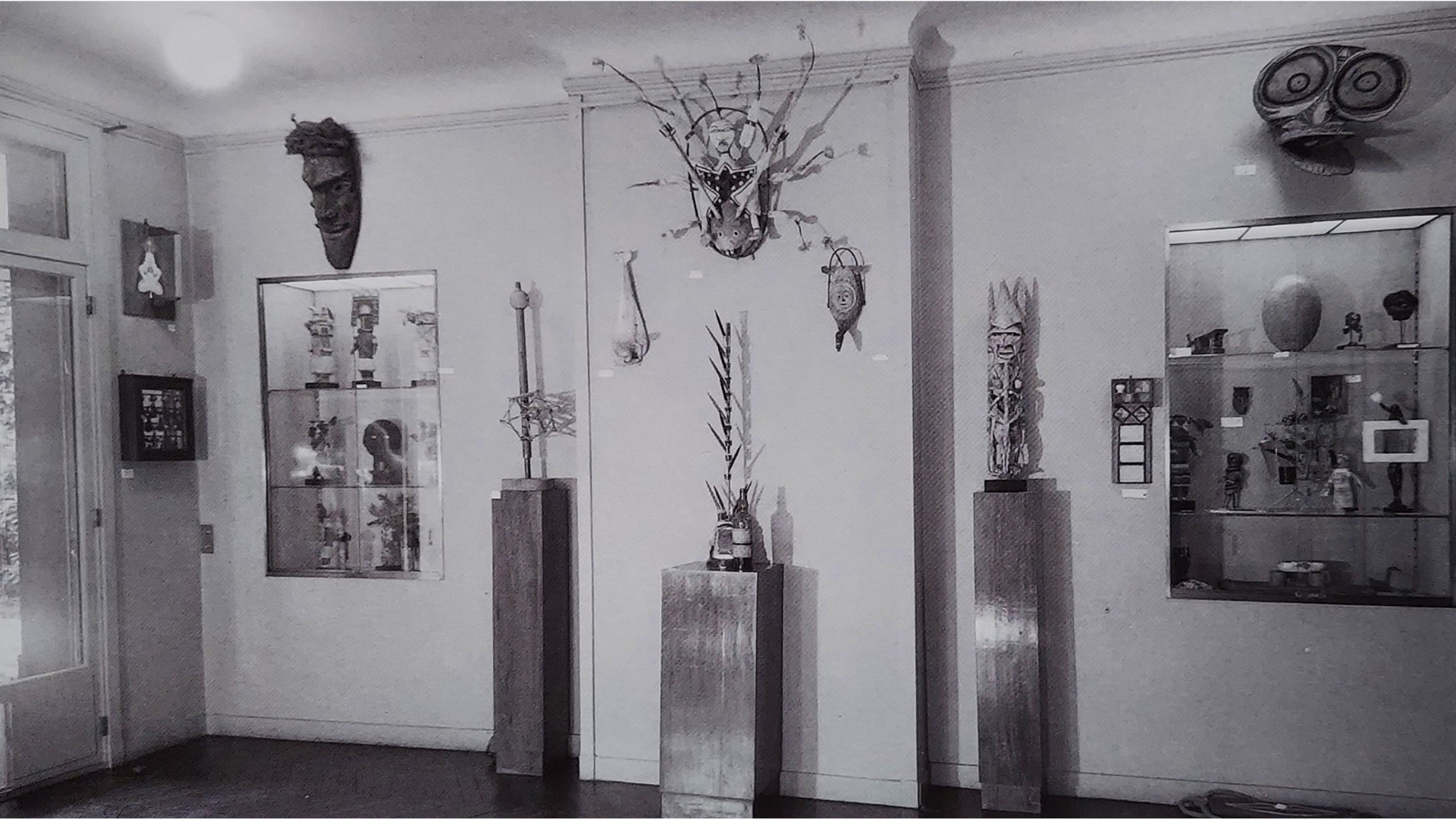
The physical journey the sugg'erpak mask took—from western Alaska to New York and eventually to Paris—is a story unto itself. It was known that the mask was collected near the mouth of the Kuskokwim River by Adam Hollis Twitchell in the early 1900s, and eventually made its way to the Museum of the American Indian in New York. Then, in the 1940s, this museum sold about two dozen Yup’ik masks collected by Twitchell during a period of financial strain. Many of these masks ended up in the hands of French Surrealists who identified with Indigenous worldviews and became fascinated by the Yup’ik dance masks.
“The masks speak loudly in relation to the Surrealist worldview,” Naves says. “The masks were the material of dreams of shamans, their visions, their encounters across worlds. And that resonated with the Surrealist movement.”
The sugg’erpak mask was acquired by Robert Lebel and ultimately entered the collection of the musée du quai Branly–Jacques Chirac, as did other masks and objects. “It was through the French Surrealism that the world became aware of Native American art,” Naves says.
Feather Science Meets Cultural Responsibility
Sugg’erpak’s story deepened when Naves asked the Feather Identification Lab of the Smithsonian Institute National Museum of Natural History in Washington, D.C., led by program manager and forensic ornithologist Carla Dove, to analyze the feathers that surround the mask.
The Feather Identification Lab is a full-time bird-strike (birds hit by airplanes) workspace that also examines feathers involved in diverse circumstances. They’ve identified bird species from feathers found in Viking Graves in Nordic countries, as well as in the stomachs of invasive Burmese Pythons in the Florida Everglades. They also regularly work with the department of Anthropology at the National Museum of Natural History in naming birds used in ethnographic objects in its collections.
“Liliana originally sent us photos of the item, but we really needed to see the feathers up close for a proper examination,” Dove says in an email. “As it turned out, Ingrid Rochon, who works in our lab, was planning to travel to France and agreed to examine the item in person.”
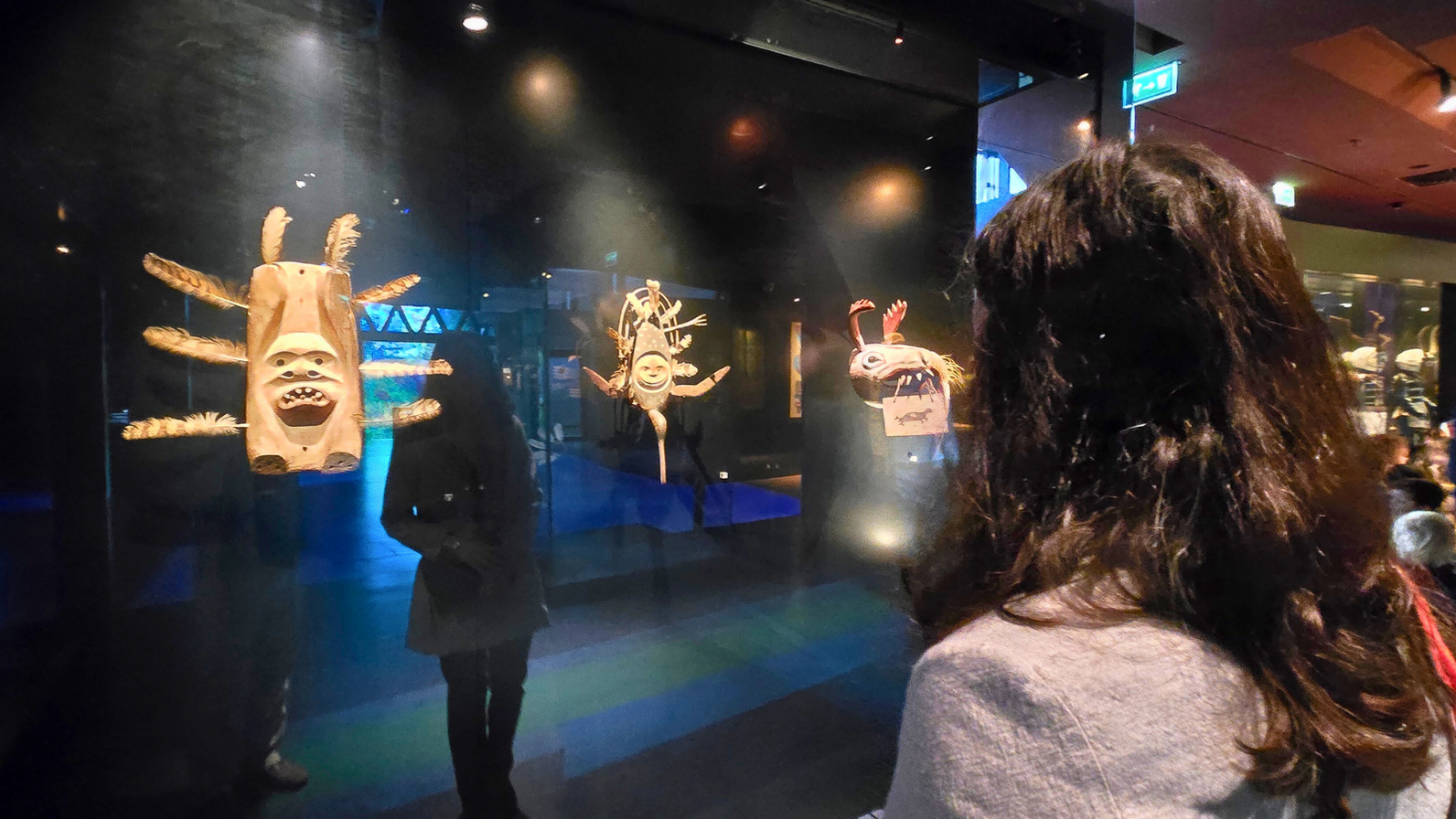
The lab discovered that some feathers were likely replacements—chicken feathers chosen to match the original hawk feathers still present in the mask. And this is common. With historic items, the original feathers can become lost or worn.
“This ‘replacement’ example is likely what happened with the Yup’ik mask,” Dove says. “While some of the feathers were from hawk, and were previously identified by another researcher, we noticed that a few of the feathers just did not match any hawk to our eye … so, the plot thickened.”
But rather than diminishing sugg’erpak’s value, Dove says this finding underscores its continued post-collection life —meaning it was handled, repaired, and cared for across generations.
“In the case of feather replacement with domestic birds (as in this specific case), we learn that the item was probably handed down to others who used it, and over time, some of the feathers went missing or had to be replaced,” she says. “They used what was available to them at the time to keep the item intact … which happened to be beautiful chicken feathers that look a lot like hawk feathers!”
Lessons for the Future
Masks like sugg’erpak once accompanied dance, song, and story—interconnected ways of recording environmental knowledge. Though many surviving masks are now displayed as art, their original purpose still resonates.
“[Masks] still serve as really important pieces for people to understand,” says Estelle Thomson. “I think that the creation of spirit masks now could be for different kinds of prayers … for our peoples to pray for the continued existence of some of these species that we are seeing declines of.”
Today, many shorebird populations face mounting threats from climate change, habitat loss, and development along migratory routes. Even the Yukon–Kuskokwim Delta may lose vast nesting habitat by century’s end—a reality Thomson meets with honesty.
“I grieved for months just thinking about how much my land is going to change … and the fact that it won't be filled with birdsong in 100 years,” she says.
Still, hope remains. “Birds are symbols of hope,” Thomson says. “Wherever there are birds, there is hope.” Yet she emphasizes shared responsibility: “We have a responsibility as human beings to take care of those that have taken care of us … and we’re not living up to that responsibility.”
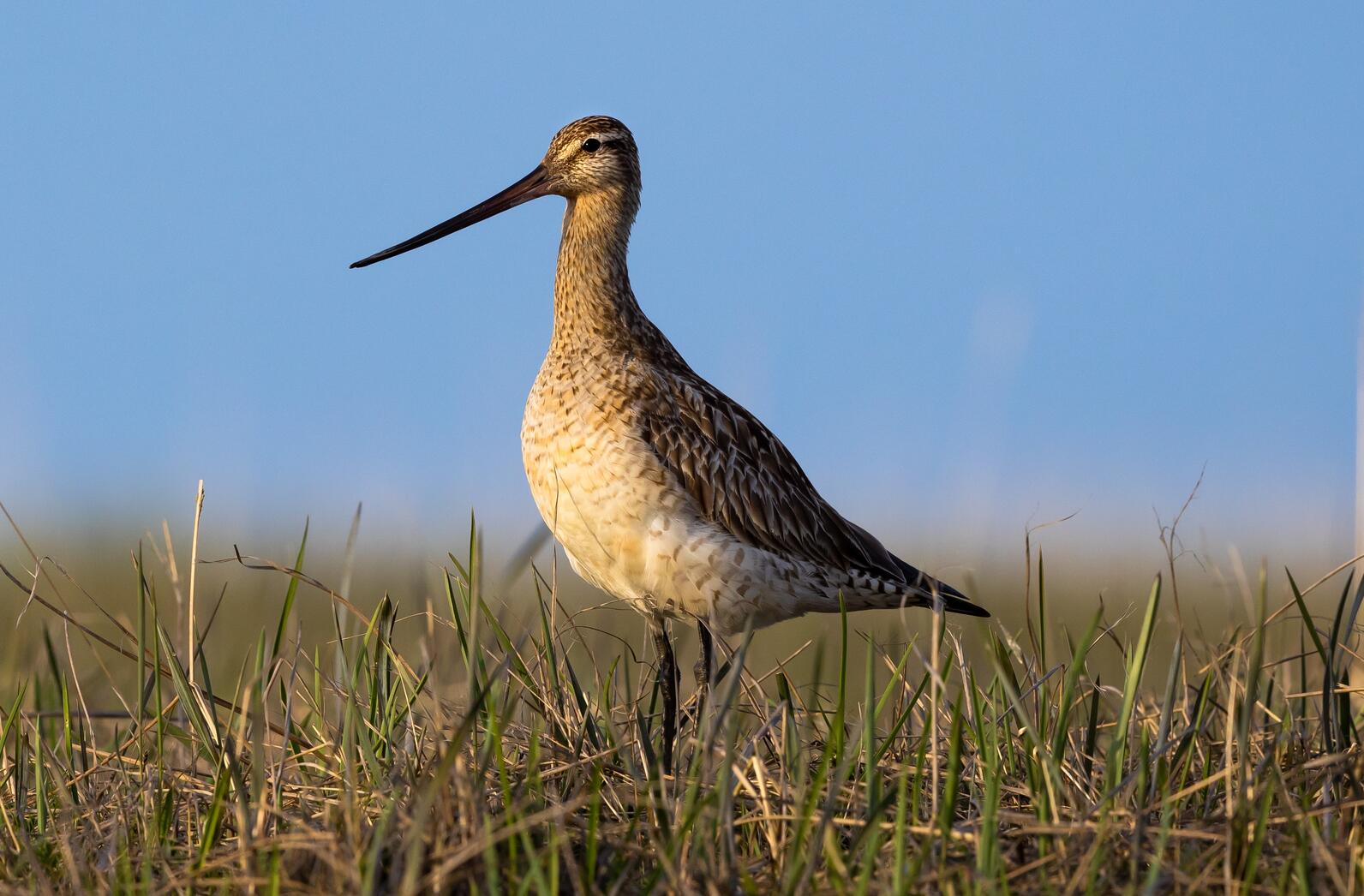
The sugg’erpak mask also reminds us that conservation is not only scientific—it’s cultural.
“Shorebirds are not particularly salient in Yup’ik culture,” says Naves. “But they are part of daily life and connected to key traditional values.”
On the Yukon–Kuskokwim Delta, shorebirds represent a small share of subsistence harvest but hold deep cultural meaning. Elders recognize the seasons by their calls, and children often develop early hunting skills through these birds. Sustaining abundance is a shared priority.
“If there are enough birds out there, hunting is sustainable, but it gets complicated if there are not enough birds,” Naves says. “That is a shared goal—we all want an abundance of birds."
For Naves, the mask underscores the importance of partnership. “I think that the Native peoples have a very powerful voice,” she says, noting that conservationists must create opportunities for inclusion while uplifting ongoing Native-led stewardship. “I think that’s how it comes together.”
A century after it was carved, sugg’erpak continues to speak—about the past, the future, and the relationships that sustain birds and people alike.