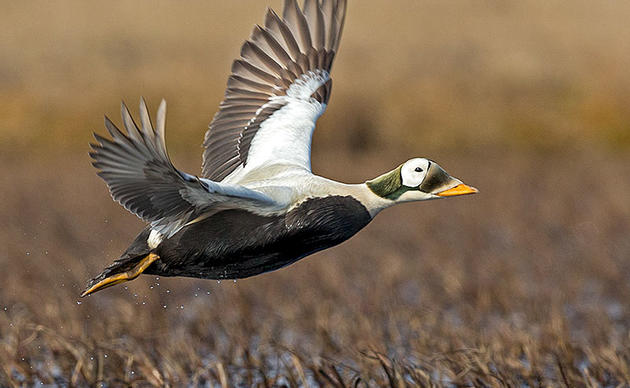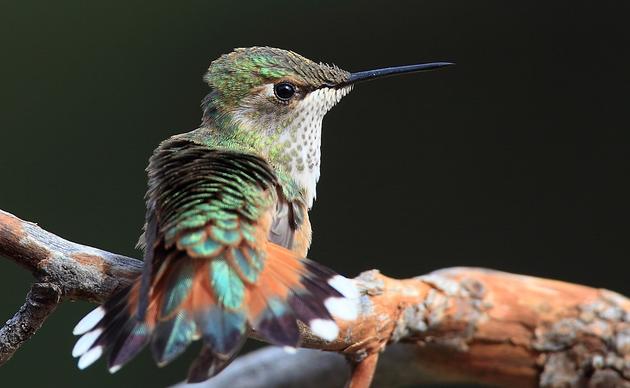
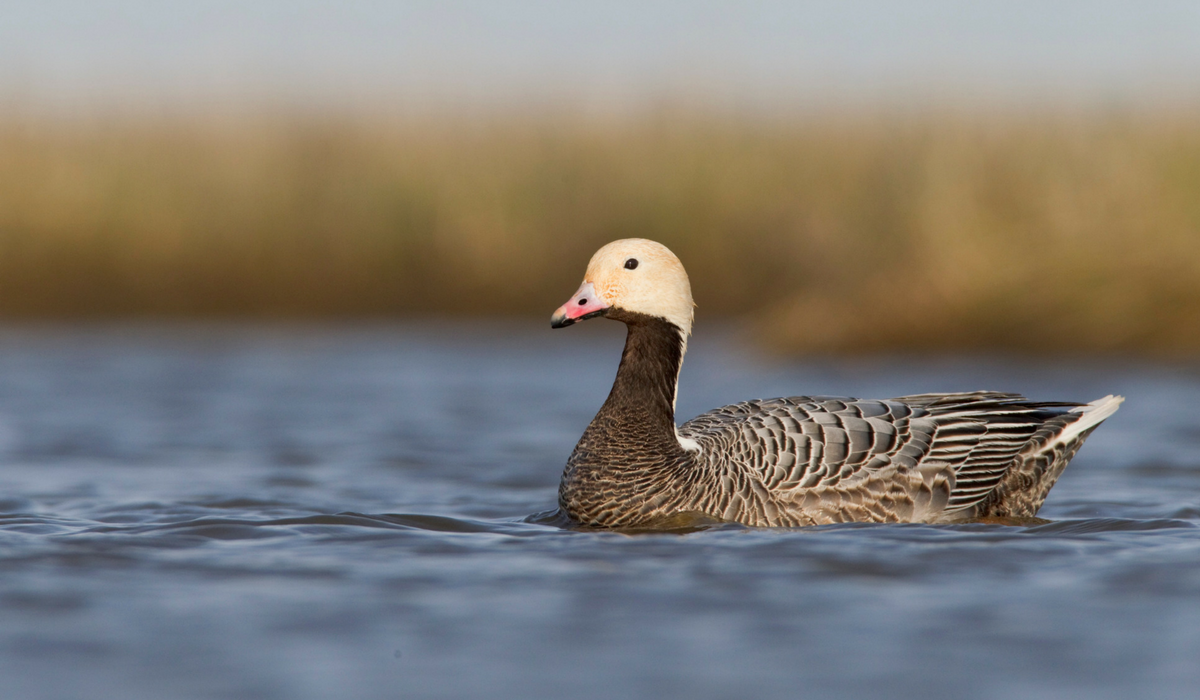
Audubon Alaska tells the Environmental Protection Agency why Bristol Bay is important for millions of birds, which the proposed Pebble Mine would put at risk. (July 2012 comments on Pebble Mine)
The magnificent Bristol Bay on Alaska’s southwest coast is a place of many superlatives. Its offshore waters support commercial fisheries for king crab, herring, halibut, pollock, and cod, while the inner bay is home to a famous sport-fishing industry, the world’s largest commercial sockeye salmon fishery, and an irreplaceable subsistence harvest of salmon, the life-blood of traditional Native cultures in the region. An estimated 40% of total U.S. fish catch comes from Bristol Bay.
Bristol Bay is also home to dozens of globally-significant Important Bird Areas and one of the world’s greatest concentrations of seabird colonies. It is an avian crossroads; four migratory flyways overlap there, with birds from Africa, Asia, the Central Pacific, and the Americas all migrating to and from the region, seeking out its diverse habitats and rich resources. Arguably, nowhere else on Earth is so important to so many birds from so many different continents.
Vast numbers of migratory waterfowl and shorebirds, including Emperor Geese and Marbled Godwits, use the wetlands, bays, and lagoons of Bristol Bay, while the offshore waters support millions of seabirds, notably Short-tailed Shearwaters and Black-legged Kittiwakes, and dozens of species of marine mammals, including the world’s most endangered whale, the North Pacific right whale. Along the Bay’s rugged coastline, more than a dozen seabird species nest on the rocky shores and cliffs, including enigmatic Whiskered Auklets and raucous Common Murres.
The Bristol Bay ecosystem is already under stress from climate change and warming ocean temperatures, but now two enormous development proposals threaten to squeeze the Bay between potential sources of massive environmental contamination—one seaward and one landward.
Pebble Mine
Offshore drilling is only the beginning of the threats to Bristol Bay. Enter the proposed Pebble Mine, a plan for an enormous opencast mine north of Iliamna Lake in the Bristol Bay headwaters. The deposit is owned by Northern Dynasty Minerals, Ltd, a wholly owned subsidiary of a Canadian company. London-based Rio Tinto, the second-largest mining company in the world, owns nearly 20 percent of Northern Dynasty. Under a new 50-50 joint venture, Pebble will be led by both Northern Dynasty and another London-based company, Anglo American, the third-largest mining company in the world.
If developed as planned, the Pebble Mine would be the largest open pit mine in North America, about two miles wide and several thousand feet deep. A second underground mine to the east would likely use a block caving method to extract ore; although this produces less waste rock, it can cause massive subsidence at the surface, allowing water to percolate down and contaminate groundwater.
Over its lifetime, Pebble Mine is projected to produce 3 billion tons of waste, which Northern Dynasty plans to contain in toxic holding ponds held behind several earthen dams, each up to 700 feet high and several miles long. The largest of these dams would be bigger than the Hoover Dam and twice as high as the tallest skyscraper in Alaska, holding back 2.5 billion tons of tailings and diverting large quantities of water from the north and south forks of the Koktuli River and Upper Talarik Creek, thus destroying sockeye spawning and coho rearing habitat in the headwaters of Bristol Bay. All of this would be sited in one of the most active earthquake zones in Alaska.
The potential impacts of Pebble Mine would reach much farther than Bristol Bay. The plan includes a proposed road from the mine round Iliamna Lake to a port on Iniskin Bay in lower Cook Inlet. The proposal calls for taxpayers to foot the bill for 90 miles of road, an estimated $150 million.
Oil and Gas Leasing
In the 1980s, large, offshore tracts of Bristol Bay were leased for oil and gas extraction, but after the Exxon Valdez spill in Prince William Sound, Congress placed the region under a drilling moratorium and, in 1995, spent $100 million to buy back the leases.
This moratorium was lifted on June 29, 2007, when former Secretary of the Interior Dirk Kempthorne approved the Minerals Management Service’s current 5-Year Program for Outer Continental Shelf Oil and Gas Leasing. The Program included planned lease sales in Bristol Bay, the Gulf of Mexico, the Mid-Atlantic, and the Beaufort and Chukchi seas. The Bristol Bay lease sale was tentatively planned for 2011 in a 5.6 million-acre area off the Alaska Peninsula.
In the meantime, the Obama Administration and its new Secretary of the Interior, Ken Salazar, are still grappling with another oil and gas leasing plan that was proposed and drafted just days before the end of the Bush Administration. The new proposed plan calls for even more accelerated leasing in Outer Continental Shelf waters across the continent, including Bristol Bay. However, Secretary Salazar delayed the plan by extending its public comment period until September 2009 to ensure that all resources were properly evaluated, including renewable energy sources. The Secretary has personally conducted four public hearings around the country, including in Alaska.
Seismic exploration, contaminated discharges, infrastructure construction, and increased vessel traffic all pose grave risks to the region’s fish, marine mammals, seabirds, and waterfowl. Moreover, with the Bay’s high winds, powerful seas, variable ice, and cold temperatures, federal agencies predict that drilling in Bristol Bay would result in at least one major oil spill of more than 1,000 barrels, in addition to numerous smaller spills. Yet there is presently no feasible method for oil spill clean-up in rough seas or ice-laden waters.
Bristol Bay at a Crossroads
Between the two proposals—onshore mining and offshore oil and gas drilling—45 recognized Important Bird Areas (IBAs) would be affected (download map and site names). Most of these IBAs are globally significant, collectively providing essential habitat for an estimated 16 million birds, including two threatened species, the Spectacled Eider and the Steller’s Eider, and at least 15 other bird species on the Alaska WatchList. These IBAs include wintering and staging areas for most of the world’s Emperor Geese and Steller’s Eiders, staging areas for tens of thousands of Marbled Godwits and other shorebird species, and colonies and adjacent marine waters where millions of seabirds nest and forage. In the event of an oil spill, any oil reaching protected lagoons, such as Izembek, could be there for decades.
Beyond these potentially devastating ecological consequences, there is a simple economic argument against the two developments: in contrast to the short-term profits of drilling and mining (the Minerals Management Service, for example, predicts that Bristol Bay off-shore drilling would produce $7.7 billion dollars in net economic value over the entire 25-40 year lifespan of the project), the natural resources of the Bristol Bay watershed are renewable and contribute $2 billion each year to Alaska’s economy. This economic value is dependent on the region’s pure clean water, healthy habitat, and pristine wilderness setting. These proposed developments pose an enormous and unacceptable risk to Alaska’s economy.
The good news is that literally dozens of stakeholder groups, often at odds in the past, have come together with a firm, common voice in opposition. This diverse coalition includes commercial and sport fishermen, subsistence harvesters, conservation groups like Audubon Alaska, native communities, and concerned citizens from across the political spectrum.
Read More
“Staking a Claim: The Battle for Bristol Bay”- Audubon magazine’s article on Bristol Bay.